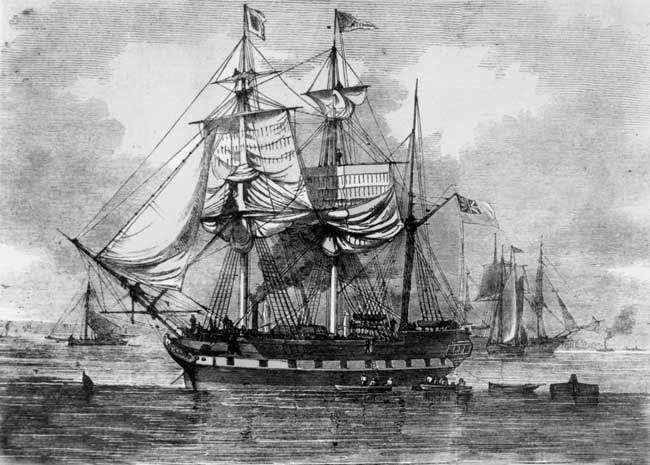

What Happened to the Rose
There is a tower at the edge of Castle Ward that most visitors walk past without stopping.
Audley’s Castle. Late medieval, four storeys, still standing on a low promontory above Strangford Lough. It has outlasted almost everything around it — including the people it once watched over.
A few hundred metres away, across open derelict ground, sits the main house. Castle Ward itself. Grand, strange, architecturally divided — one half classical, one half gothic — because the husband and wife who built it couldn’t agree on a style. Even the house contains an argument that was never resolved.
I’ve walked that ground between the tower and the house. It feels emptier than it should. Not wild, not overgrown — just open in a way that doesn’t feel natural. Like something was removed and the land never quite recovered its shape.
Something was.
In the mid-nineteenth century, roughly 250 people lived at Audley’s Town, a settlement on the Castle Ward estate above the lough. Farmers and families — the Hinds, the Smyths, the O’Connors. People whose roots in that ground went back generations. By 1852, they were gone.
The tenants were placed aboard a vessel called The Rose, sailing from Strangford. The stated destination was Boston. No record exists of the ship or its passengers ever arriving.
I want to be careful here, because the historical record is not clean. No one has proven, definitively, what happened to The Rose or the people on it. Some historians believe the vessel reached America under a different record. Others are less generous. What can be said with certainty is this: twenty-five families boarded a boat and disappeared from history, and the land they left behind was replanted with a hundred acres of woodland within a few years, as though the priority had always been erasure rather than emigration.
By 1859, the clusters of cottages recorded on the 1834 Ordnance Survey were gone. In their place — trees. The kind of deliberate, large-scale planting that takes planning, intention, and money.
Local historian Brian Fitzsimmons has noted that from the rear of Castle Ward, the estate appears to merge with the neighbouring Nugent estate across the narrow stretch of lough — and that the removal of the settlement completed that illusion of uninterrupted, seamless land. Harriet Ward, who lived at Castle Ward during this period, later married Major Savage-Nugent. She became known locally as The Evictor.
The National Trust archaeologist Malachy Conway once described the site of Audley’s Town as obliterated. Brian Fitzsimmons called it a place that’s almost impossible to find.
I stood in Harriet’s bedroom at Castle Ward. Her portrait hangs above the fireplace — painted around 1850, the same decade the families disappeared. She looks composed. Assured. The kind of woman who has never had to justify herself to anyone who mattered.
Below the bedroom window, across that open derelict ground, Audley’s Castle still stands. The tower that outlasted everything. The families who lived in its shadow did not outlast anything. They boarded a boat and the record closes.
What happened to The Rose? The honest answer is that nobody knows. What happened to the Hinds, the Smyths, the O’Connors — nobody knows that either. The land was replanted. The view improved. The map changed.
That silence is what first pulled me toward this story. Not the mystery of what happened — though that is real — but the efficiency of the forgetting. The way a community of 250 people can be removed from a landscape so thoroughly that a century and a half later, the site is described as obliterated and almost impossible to find.
What the Fog Conceals is not a retelling of what happened at Audley’s Town. But it was born from that silence — from standing on that open ground and understanding that some absences are not accidental.
They are decisions.
Leave a Reply