There is a habit, in English Gothic, of drawing a firm line between the rational world and whatever trespasses upon it. The house is sane until the stranger arrives. The village is ordinary until the letter is opened. The ghost is the exception, and the story is the restoration of order, or the tragedy of its failure.
Irish Gothic does not work this way. It has never worked this way.
In the Irish tradition, the threshold between the known and the unknown is not a line a story crosses once — it is a condition the landscape lives inside. There is no sane house waiting to be disturbed. The disturbance is already there, in the stone, in the water, in the names no one says aloud after dark. The work of the novelist is not to introduce the uncanny. It is to admit that one has been writing inside it the whole time.
This is the first thing to understand about Irish Gothic, and it is the thing that most often gets lost when the tradition is discussed. The rest, the folklore, the ruins, the famine memory, the mist, follows from it. But the structural fact comes first: in this literature, the threshold does not hold. It was never meant to.
The Inherited Landscape
Begin with the ground. Ireland is a country where the supernatural is topographical. The raths and the fairy forts are not imagined places; they are marked on ordnance survey maps. Farmers still refuse to plough through them. When the motorway planners tried to route the M3 through the Tara-Skryne valley in the 2000s, the objection was not only archaeological. It was older than that, and it was serious.
This is not quaintness. It is a tradition of paying attention. The land has been watched and remembered, house by house and townland by townland, for longer than the written record. And what that watching produced was a shared understanding that certain places are not fully available to the living. They are withheld. They keep their own logic. If you build on them, something will go wrong — not dramatically, not like a film — but steadily, in the way a hinge begins to stick, or a child goes quiet, or a marriage loses the thread of itself.
The English Gothic novel imports its haunted houses. Someone inherits a manor from a distant relative and finds the portrait moves. The Irish Gothic novel does not need to import anything. The house is already standing on ground the builders were warned about. The warning was ignored because the builders were from somewhere else. This is, among other things, a literature of unheeded local knowledge.
It is no accident that so many Irish Gothic novels turn on inheritance, on ledgers, on the return of an absent son, on the quiet arithmetic of what a family owes and to whom. The colonial structure of Irish land ownership, the Big House standing in the middle of a tenantry whose history precedes it by a thousand years, produced a Gothic that is about occupation in the literal sense. The house is full. It is full of the people who lived on the land before the house was there, and it is full of the ones who tried to live in it afterwards, and none of them have finished.
What the Aos Sí Refuse
The Good People are the clearest expression of this, and also the most misunderstood.
In the imported Gothic tradition, the supernatural figure is either a victim of past wrong returning for justice, or a malign intelligence breaching a boundary. The ghost has motive. The demon has appetite. Even Dracula, the great imperial Gothic, works because his hunger is legible. You can fight him. You can stake him. The story is legible because the threat is a character.
The Aos Sí are not a character. They are a system. They operate on a logic that precedes human time and does not concede ground to it. They are not evil. They do not want anything from you in the way that a ghost wants anything. They have already arranged themselves, and the arrangement includes the possibility that something of yours will, one day, be required. A child who goes into the rath and comes back wrong has not been cursed. He has been corrected. The correction is not personal. The Hill does not know your name.
This is a profoundly difficult idea to carry into a novel, because it resists the emotional beats the contemporary reader expects. There is no confrontation scene in which the protagonist out-argues the fairy queen. There is no final banishment. You do not defeat the Aos Sí. You negotiate with them, or you ignore them at a cost that may not come due for a generation, or you discover that the thing you loved most was theirs to begin with.
When I write the Good People into fiction, I am not writing them as monsters. I am writing them as a grammar the story has to learn to speak. They are what the sentence does when it refuses to end the way the English language says it should. They are the reason a passage will not resolve. They are the edit the book is making upon itself while you read it.
What Returns, and in What Condition
The other great Irish Gothic subject, perhaps the greatest, is the returned figure. The one who was gone and is now back. The one who went into the fog, or under the hill, or across the water, and came home altered.
This is the deepest vein of the tradition, and it is why Irish Gothic novels so often concern themselves with children, with siblings, with the dead who will not consent to be dead. The returned figure is not a ghost in the English sense. She is not insubstantial. She sits at the kitchen table. She uses the same words she used before. She looks, to the quick glance, like herself.
But something has been replaced.
Something has been swapped out while she was away, and the family can feel it, and the family cannot name it, and the not-naming is the horror. In folklore this is the changeling. In the novel it is what happens to a wife after a stillbirth, or to a son after he goes to the war, or to a mother after she holds her last parent’s hand in the cold hour before dawn. Irish Gothic fiction understands that grief and the uncanny are not separate categories. Grief is the most common form the uncanny takes. The changeling story is not a superstition. It is a technology for describing what a family sees, and cannot say, when one of its own has been changed by an experience the rest of them did not share.
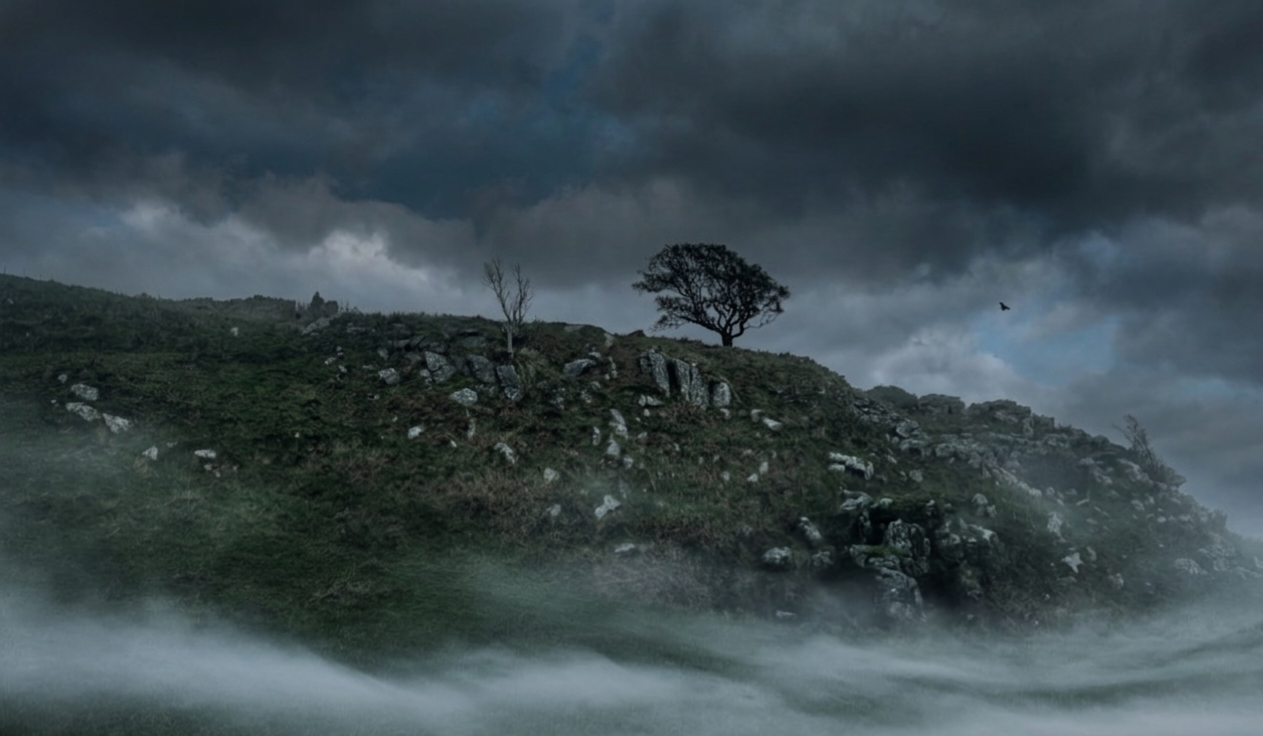
My own work, the novel I wrote first, and the one I am writing now, turns on this. What the Fog Conceals is set in 1852, in a house where the land outside the windows is vanishing piece by piece. The fog is not a symbol. It is the landscape doing the work the landscape has always done in this tradition: withholding itself until the people inside the house admit what they know. The novel is not a mystery to be solved. It is a reckoning to be arrived at. The difference matters. Mysteries end. Reckonings do not. They settle into the furniture.
The second novel, which will follow the first in its time, sits on an island off the west coast in 1893, with a widow and her nine-year-old son, and the old fortress behind the house, and the ash that trembles toward the boy’s hand. I will not say more about it yet, except that it is a book in which a mother discovers that the thing she has been fighting to protect her son from is a debt that was arranged before she was born, and that it was arranged using her own blood. That is an Aos Sí story. It is also a Gothic story. In the Irish tradition, these are the same story.
Against Consolation
What Irish Gothic refuses, finally, is consolation. And this is the thing that modern genre publishing most often wants to reinstate, and the thing I believe writers of the tradition have to hold the line against.
The English ghost story, in its great period, offered a form of reassurance. The haunting was an ordered thing. The past had a grievance, the grievance was articulable, and the story’s work was to articulate it. Once named, the ghost could be laid. This is why M. R. James still comforts us. His horrors are legible. They are not nice, but they are knowable.
The Irish tradition does not do this. The haunting in Maturin, in Le Fanu, in Banville, in McCabe, in the contemporary work of writers like Jess Kidd and Sarah Moss when they turn toward the Irish material — the haunting does not come apart when you name it. You can name it perfectly and it will still be there tomorrow. This is not a failure of the genre. It is the genre. It is the thing the genre was invented to say.
There is a reason for this, and it is political as well as aesthetic. The Irish experience of history is of loss that was not repaid and injury that was not acknowledged. The Famine is not a past event that has been put down. The emptied townlands are not ruins from a closed chapter. A literature that comes out of this ground cannot, in honesty, produce a ghost that gets laid at the end of chapter twelve. The ghost does not get laid. The ghost stays. The literature is about learning to live in a house with the ghost and knowing that you will not outlive its tenancy.
This is not pessimism. It is a different structure of hope. The hope in Irish Gothic is not that the past will release its grip. It is that someone, inside the grip, will still choose to act. The widow holds onto the child. The daughter refuses the ledger. The son walks back into the fog because it is his mother’s fog and she is still inside it. These are not victories. They are refusals. In this tradition, a refusal is enough. A refusal is the whole moral architecture of the book.
For the Reader
If you come to Irish Gothic expecting the shape of an English ghost story, you will be disappointed, and the disappointment will feel like the book’s failure. It is not. The book is doing a different thing. It is declining to resolve. It is insisting that what haunts the characters will not be neatly dismissed, because in the country the book comes from, nothing has been neatly dismissed, and the literature is honest about that.
What the tradition offers, in exchange for the consolation it withholds, is something rarer. It offers the reader the experience of a world where the unseen has weight. Where the landscape is full. Where the dead are not absent, only quieter than they were. Where a house might be remembering what its people have forgotten, and where the act of reading — slow, careful, attentive — becomes, for a while, indistinguishable from the act of listening.
This is what the books are for. This is what I am trying to write. And if the essay has a conclusion, it is only this: when the threshold in the story will not hold, do not treat it as a flaw. Treat it as the door the writer left open on purpose. Go through it. See what is on the other side. Something will be there. In this tradition, something is always there.
R. A. Marno
What the Fog Conceals is published by Salt Publishing in August 2026.
Leave a Reply